
Florida’s Pregnancy Parking Permit Debate: Pregnancy Permits and the Fight for Accessibility
Florida has no shortage of debates, but few have sparked as much statewide conversation as the new law allowing pregnant women to obtain disabled parking permits. What began as a well‑intentioned effort to support expectant mothers has quickly become one of the most polarizing accessibility issues in the state. Disability‑rights advocates, business owners, and lawmakers are now locked in a heated discussion about fairness, legality, and the real‑world impact on people who rely on accessible parking every day.
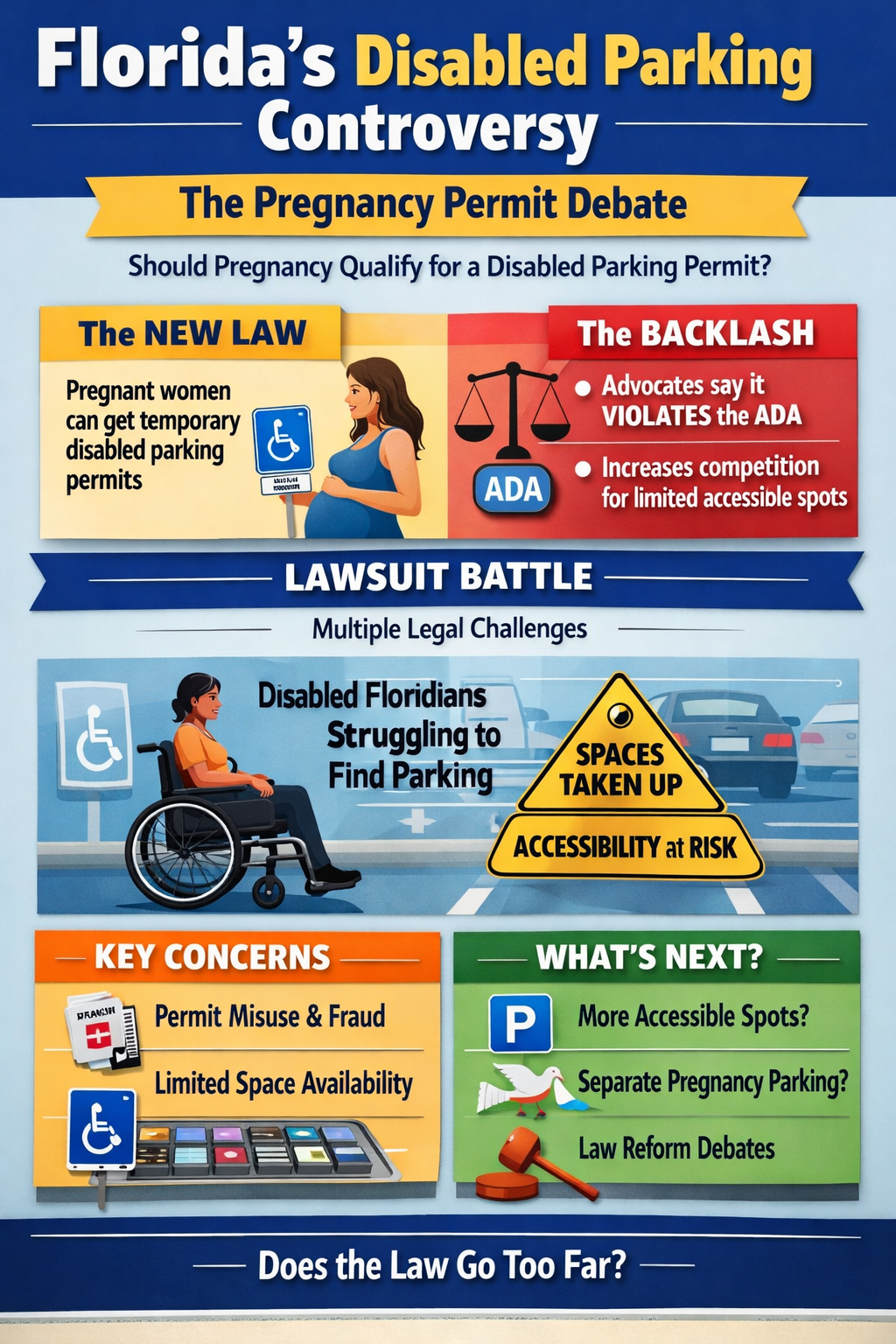
At the center of the controversy is a simple but powerful question: Should pregnancy—without a mobility impairment—qualify someone for a disabled parking permit? Florida lawmakers said yes. Disability advocates overwhelmingly say no.
Why the Law Sparked a Firestorm
The law, passed with bipartisan support, allows pregnant individuals to obtain a temporary disabled parking placard. Supporters argue that pregnancy can involve physical strain, dizziness, swelling, and medical complications that make walking long distances difficult. They frame the law as compassionate and practical. This has sparked a pregnancy parking permit debate.
But disability‑rights groups see a very different picture.
Accessible parking spaces are already limited, and many Floridians with permanent mobility impairments report that they routinely struggle to find available spots. Adding tens of thousands of new eligible applicants—most of whom do not have mobility disabilities—creates a supply‑and‑demand crisis that disproportionately harms those who need these spaces the most.
This tension has now escalated into multiple lawsuits, including federal challenges arguing that the law violates the Americans with Disabilities Act (ADA). One lawsuit was dismissed on procedural grounds, but the broader legal battle continues.
Real‑World Impact on Disabled Floridians
For many disabled residents, this isn’t a theoretical debate—it’s a daily obstacle.
People who use wheelchairs, walkers, or mobility aids often require the extra space provided by van‑accessible spots. When those spaces are taken, they may be forced to park far from entrances or skip appointments entirely. Some report being unable to safely exit their vehicles without the wider access aisles.
The pregnancy‑permit law, they argue, prioritizes convenience over necessity.
Enforcement and Fraud Concerns Add Fuel to the Fire
Florida already struggles with disabled‑parking permit misuse. State officials estimate that up to one in four placards may be used fraudulently, whether borrowed, forged, or improperly renewed. Law enforcement has increased crackdowns, issuing fines up to $1,000 and even jail time for repeat offenders.
Adding a new category of eligible users—one that is difficult to verify and easy to exploit—raises concerns that misuse will only increase.
What Comes Next?
Lawmakers are now considering adjustments, including:
- Increasing the number of accessible spaces required in commercial lots
- Creating a separate category of “pregnancy parking” distinct from ADA spaces
- Tightening enforcement and verification standards
Meanwhile, disability‑rights groups continue to push for repeal or revision of the law, arguing that accessibility should never be diluted for those who depend on it for safety and independence.
The Bottom Line
Florida’s pregnancy‑permit law has ignited a statewide conversation about what accessibility really means—and who it is meant to protect. As lawsuits move forward and lawmakers revisit the issue, one thing is clear: disabled Floridians are demanding that their needs remain at the center of the discussion.
Why Pregnancy Permits Sparked a Statewide Accessibility Battle
Florida is no stranger to heated policy debates, but few issues have ignited as much controversy as the state’s new rule allowing pregnant women to obtain temporary disabled parking permits. What was introduced as a compassionate, family‑friendly measure has quickly become one of the most divisive accessibility topics in the state. Disability‑rights advocates, lawmakers, and everyday Floridians are now wrestling with the same question: Does this law expand support — or dilute essential protections for people with disabilities?
A Well‑Intentioned Law With Unintended Consequences
The law’s premise seems simple. Pregnancy can involve physical strain, swelling, dizziness, and medical complications that make walking long distances difficult. Supporters argue that offering temporary disabled parking permits is a practical way to ease daily challenges for expectant mothers.
But disability‑rights groups see a deeper problem: pregnancy is not a mobility impairment, and accessible parking is already in short supply. Adding thousands of new eligible users — most of whom do not require mobility aids — threatens to overwhelm a system designed for people who rely on these spaces for safety and independence.
This tension has escalated into multiple lawsuits, including federal challenges claiming the law violates the Americans with Disabilities Act (ADA). While one case was dismissed on procedural grounds, the broader legal fight is far from over.
The Real‑World Impact on Disabled Floridians
For people with mobility disabilities, accessible parking is not a convenience — it’s a necessity. Wheelchair users, individuals with walkers, and those with chronic mobility‑limiting conditions often require van‑accessible spaces with extra room to deploy ramps or safely exit their vehicles.
When these spaces are full, the consequences are immediate and serious:
- Missed medical appointments
- Unsafe parking far from entrances
- Inability to exit a vehicle without assistance
- Increased risk of falls or injury
Many disabled Floridians say the pregnancy‑permit law has already made it harder to find available spaces, especially in crowded commercial areas.
Fraud and Enforcement Concerns Add Pressure
Florida already battles widespread disabled‑parking permit misuse. State officials estimate that up to 25% of placards may be used improperly, whether borrowed, forged, or expired. Law enforcement has increased crackdowns, issuing fines up to $1,000 and even jail time for repeat offenders.
Critics argue that adding a new, loosely defined eligibility category — one that is difficult to verify — opens the door to even more misuse.
Lawmakers Consider Adjustments
In response to public pressure, legislators are exploring several potential changes:
- Increasing the number of required accessible spaces in commercial lots
- Creating a separate “pregnancy parking” category distinct from ADA spaces
- Tightening medical‑verification requirements
- Revisiting the law entirely if lawsuits succeed
Disability‑rights organizations continue to push for revisions, emphasizing that accessibility protections must remain centered on those with permanent mobility impairments.
A Debate That Isn’t Going Away
Florida’s pregnancy‑permit law has sparked a broader conversation about what accessibility means — and who it is meant to protect. As legal challenges continue and lawmakers consider revisions, one thing is clear: disabled Floridians want their voices at the center of the discussion.
This debate isn’t just about parking spaces. It’s about fairness, safety, and ensuring that accessibility laws remain true to their purpose.
If you wish to get a disabled parking permit for pregnancy, HandicapDocs generally does NOT sign these forms We suggest you call your treating OB/GYN or specialist.