
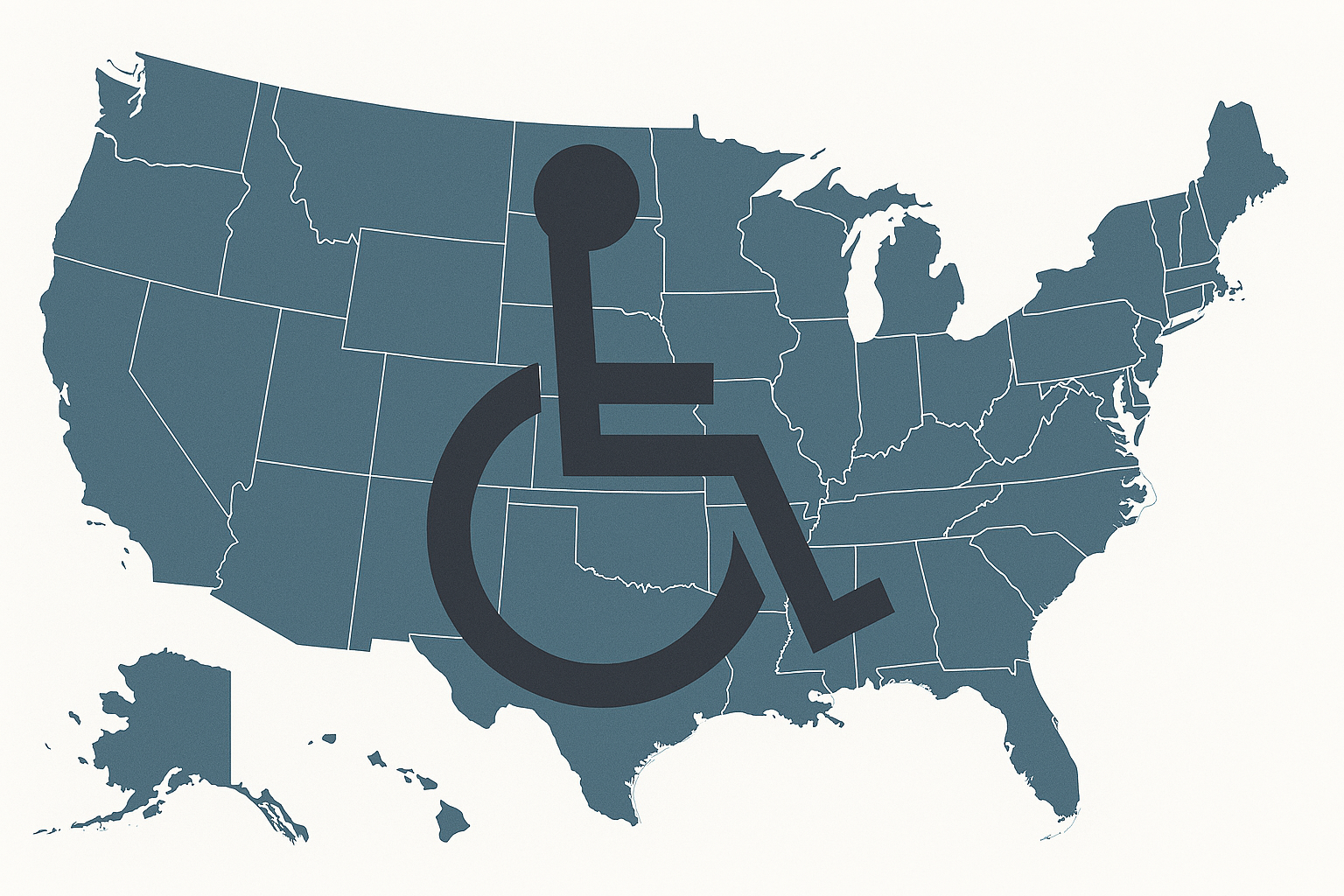
Understanding Disability in America: Challenges, Innovations, and Expert Insights
By: Dr. Alan Himmel
Disability touches every part of society. More than one in four adults in the United States lives with some type of disability, according to the CDC. That’s over 61 million people managing daily life with challenges in mobility, vision, hearing, cognition, independent living, or self-care. Despite the size of this community, disability challenges and accessibility solutions is often misunderstood, under-represented, and surrounded by outdated assumptions.
This article offers a clear, well-researched look at disability challenges and accessibility solutions in the US—using national data, expert interviews, real-world experiences, and solutions that are shaping the future of accessibility. Whether you work in healthcare, social services, policy, education, or are simply a community member who wants to understand disability better, this guide aims to make the topic approachable and meaningful.
What Disability Really Means
Disability is not just a medical or physical condition. Disability is the interaction between a person’s health, their environment, and the barriers around them.
A person may experience disability if they have:
- A physical or mobility impairment
- A sensory condition (like hearing or vision loss)
- A cognitive or processing difference
- A mental or emotional health condition
- A chronic illness
- A developmental disability
Disability does not define a person. It is one part of their lived experience.
The World Health Organization emphasizes that disability is shaped by context: housing, transportation, technology, employment policies, education systems, and societal attitudes all play major roles in shaping a person’s ability to participate fully in life.
Most Common Disabilities in the United States
According to the CDC’s Behavioral Risk Factor Surveillance System (BRFSS), these are the most common disabilities:
- Cognitive disability – 13.9%
- Mobility disability – 12.2%
- Independent living difficulty – 7.7%
- Hearing disability – 6.2%
- Vision disability – 5.5%
- Self-care disability – 3.6%
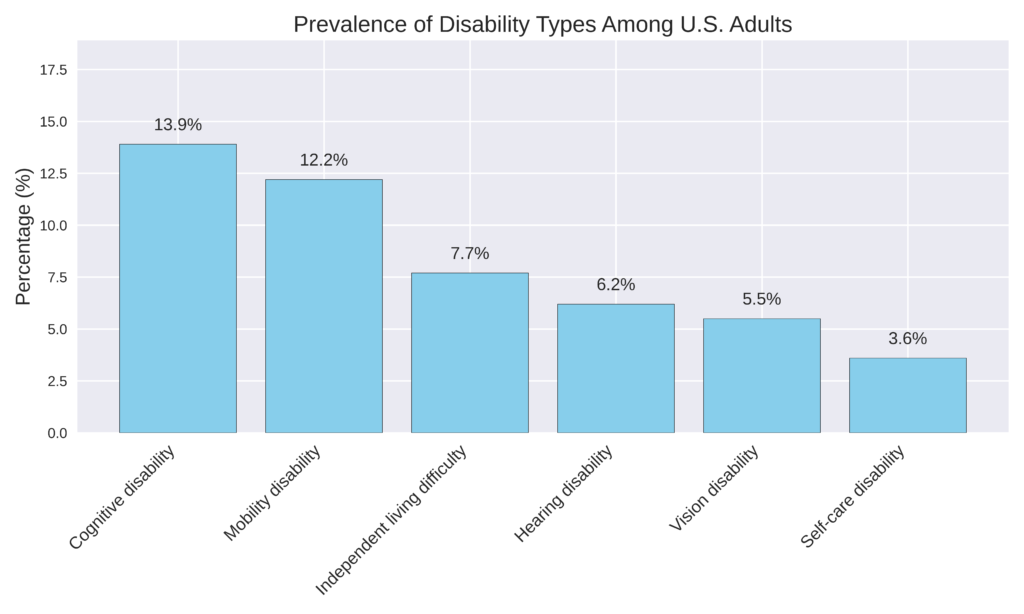
Mobility and cognitive disabilities remain the most widely reported. This aligns with trends in aging populations, chronic illnesses, and the continued need for mental-health awareness and support.
What Causes Disability?
Disabilities can be congenital (present at birth), acquired early in life, or develop due to accidents, illness, aging, or environmental factors. Common causes include:
- Neurological conditions: stroke, traumatic brain injury, multiple sclerosis, epilepsy
- Musculoskeletal issues: arthritis, spinal cord injury, limb loss
- Chronic diseases: diabetes, heart disease, cancer
- Sensory impairment: hearing loss, vision loss
- Developmental conditions: autism, Down syndrome, cerebral palsy
Social and economic factors—such as access to healthcare, safe living environments, or nutrition—also heavily influence the onset or severity of disability.
Employment & Economic Barriers
Employment continues to be one of the most significant barriers for people with disabilities. While progress has been made since the signing of the Americans with Disabilities Act (ADA), employment gaps remain sharp.
According to the U.S. Bureau of Labor Statistics (2024):
- Only 22.7% of Americans with disabilities are employed.
- 65.5% of people without disabilities are employed.
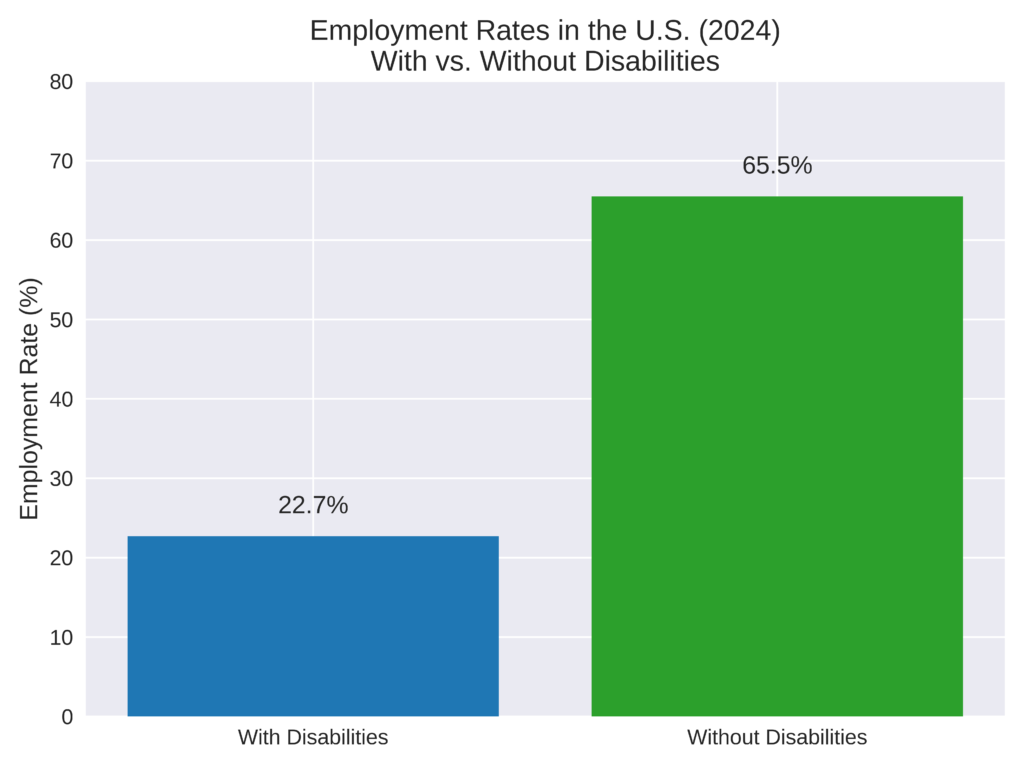
This difference is not due to lack of talent or ability. Research consistently shows that people with disabilities often face:
- Physical and digital accessibility barriers
- Employers who are unfamiliar with accommodations
- Transportation challenges
- Bias in hiring practices
- Inflexible work environments
Expert Interview #1: The Clinical Perspective
Interview with Dr. Mara Feldstein, Neurologist & Disability Advocate
Q: What is the biggest misconception you see about disability?
Dr. Feldstein: “People often think disability equals inability. Many of my patients have advanced degrees, families, careers—what they lack is not capability but access. Small accommodations often make an enormous difference.”
Q: What kinds of accommodations matter most?
Dr. Feldstein: “Flexibility is huge—remote work, mobility aids, adaptive software, captioning services. Also, clear communication. Patients with cognitive or neurological disabilities often benefit from instructions in multiple formats.”
Q: What should the public understand?
Dr. Feldstein: “Disability is the only demographic group anyone can join at any time. Building accessible systems benefits all of us, not just those currently living with disabilities.”
Expert Interview #2: Lived Experience
Interview with Jordan McClain, Disability Rights Speaker (Mobility + Vision Disability)
Q: What’s the hardest part about navigating daily life with a disability?
Jordan: “The physical challenges are manageable. It’s the environmental challenges—curbs without ramps, buildings without elevators, apps that aren’t compatible with screen readers. Those create more barriers than my disability itself.”
Q: What do people often get wrong?
Jordan: “People assume accommodations are burdens. Actually, they help me contribute more. Accessibility isn’t charity—it’s equal access.”
Q: What gives you hope?
Jordan: “Technology. Voice-to-text, AI-powered navigation tools, adaptive sports programs, smart homes—these innovations are opening doors that have been closed for generations.”
Combatting Barriers: What Actually Works
1. Universal Design
Universal Design encourages creating spaces, tools, and systems that work for everyone, regardless of ability level. Examples include:
- Curb cuts
- Automatic doors
- Large-print signage
- Adjustable-height desks
- Closed captions
- Accessible websites
What began as disability accommodation is now standard convenience for all.
2. Better Workplace Policies
Workplaces that adopt flexible policies see higher productivity and lower turnover among employees with disabilities. Examples:
- Remote or hybrid work
- Modified schedules
- Clear emergency evacuation plans
- Paid caregiver leave
- ADA-compliant digital platforms
3. Transportation Improvements
Accessible transportation improves independence, employment, and health outcomes. Key improvements include:
- Low-floor buses
- Paratransit systems
- Ride apps with wheelchair-accessible vehicles
- Audible crosswalk signals
- Wayfinding tools
4. Healthcare Access
People with disabilities often face barriers to healthcare itself, including:
- Non-accessible exam equipment
- Providers who lack disability training
- Limited accessible communication
Training programs and universal medical equipment standards are helping close this gap.
5. Technology & Assistive Devices
Modern assistive technology goes far beyond wheelchairs and hearing aids.
Innovations include:
- AI-powered speech-to-text
- Smart canes
- GPS-based indoor navigation
- Adaptive gaming controllers
- Eye-tracking communication systems
- Wearable fall-detection devices
Why Accessibility Matters for Everyone
When society improves accessibility, the benefits extend far beyond the disability community. Examples:
- Captions help people in noisy environments.
- Curb cuts help parents pushing strollers.
- Flexible work benefits caregivers and parents.
- Clear signage helps people with low vision and non-native English speakers.
Accessibility equals usability—for everyone.
Resources and Organizations Supporting Disability Inclusion
These organizations offer education, advocacy, research, and community support:
- Centers for Disease Control and Prevention (CDC): Disability & Health Program
https://www.cdc.gov/ncbddd/disabilityandhealth/ - U.S. Department of Labor – Office of Disability Employment Policy (ODEP)
https://www.dol.gov/odep - American Association of People with Disabilities (AAPD)
https://www.aapd.com - National Council on Independent Living (NCIL)
https://ncil.org - The Arc (Intellectual and Developmental Disabilities)
https://thearc.org - National Federation of the Blind (NFB)
https://nfb.org - Hearing Loss Association of America (HLAA)
https://hearingloss.org
Conclusion
Disability is not a fringe issue—it is a central part of human diversity. Creating a more accessible, inclusive society benefits everyone. The data is clear: barriers persist, but solutions exist, and they work. With better awareness, thoughtful policy, and continued advocacy, we can build a world where every person has the opportunity to participate fully and independently.
This blog post is a step toward that goal—offering clearer understanding, stronger data, and real voices from the disability community.
Sources
- Centers for Disease Control and Prevention. Behavioral Risk Factor Surveillance System (BRFSS), Disability & Health Data System.
https://www.cdc.gov/brfss - U.S. Bureau of Labor Statistics. Persons With a Disability: Labor Force Characteristics Summary (2024).
https://www.bls.gov - World Health Organization. Disability and Health.
https://www.who.int/news-room/fact-sheets/detail/disability-and-health
Americans with Disabilities Act (ADA) National Network.
https://adata.org